

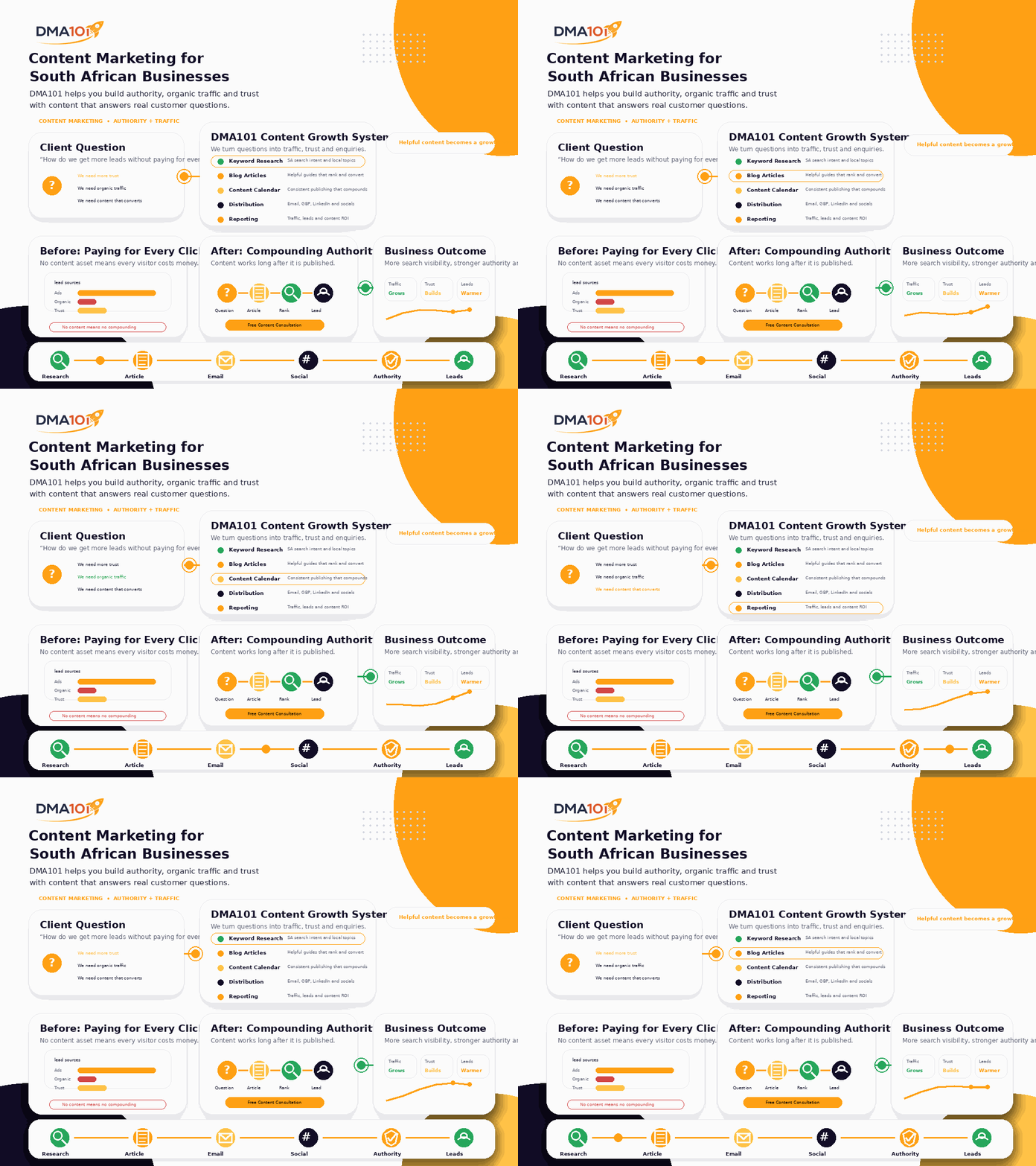
Content marketing generates over three times as many leads as outbound marketing and costs 62% less. Companies with active blogs generate 67% more leads per month and 55% more website traffic than non-blogging competitors. A blog post published today continues generating organic traffic and leads for an average of 3.5 years.
These are not small advantages. They represent a fundamental shift in how the most successful South African businesses are building sustainable growth. While competitors are paying for every click, every lead, and every impression through paid advertising, businesses with strong content marketing programmes are generating leads from articles written months or years ago, at zero marginal cost per lead.
This guide explains what content marketing is, why it works specifically in the South African market, and how to build a strategy that compounds over time.
The Content Marketing Advantage
Content marketing generates $3 for every $1 invested on average, compared to just $1.80 for paid advertising. This 67% performance advantage stems from content's compound value. Once created, quality content continues generating organic traffic and leads without ongoing costs.
What Is Content Marketing?
Content marketing is the practice of creating and distributing valuable, relevant content to attract and retain a clearly defined audience, and ultimately drive profitable customer actions. Instead of interrupting your potential customers with advertising, you create content they actively seek out because it answers their questions, solves their problems, or helps them make better decisions.
In practical terms for a South African small business, content marketing means:
- A digital marketing agency in Kimberley publishing articles like "How much does Google Ads cost in South Africa?" and attracting business owners researching paid advertising.
- A plumber in the Northern Cape publishing "How to prevent burst pipes during extreme temperature changes" and ranking when local homeowners search for that advice.
- A solar installer publishing "How long does a solar installation take in the Northern Cape?" and capturing procurement-intent searches before competitors even appear in the results.
In each case, the content earns attention from people who are actively researching a problem, positions the business as knowledgeable and trustworthy, and converts a portion of those readers into enquiries.
The Business Case for Content Marketing in South Africa
The data on content marketing ROI is compelling, particularly for South African businesses operating with limited budgets and looking for long-term, sustainable growth channels.
Higher Conversion
B2B blogs generate 67% more leads per post and have a 2.1x higher conversion rate than general content.
Compounding ROI
Content marketing typically takes 6 to 12 months to show measurable ROI, but the ROI compounds significantly after month 12.
For South African SMEs navigating tight budgets and tough competition, this trajectory is both the main challenge and the primary strategic advantage of content marketing. The South African businesses that start investing in content now will hold compounding organic authority that becomes increasingly expensive for late movers to replicate.
Why Content Marketing Is Different in South Africa
A strategy that works overseas does not automatically translate locally. South African audiences browse mostly on mobile, are conscious of data costs, and respond to content that reflects their context, currency, local examples, and the specific problems they face.
-
Mobile-first consumption
Your content must be easily digestible, fast-loading, and visually appealing on smartphones.
-
Local context resonates
SA readers engage more deeply with content that acknowledges their reality: Rand-based pricing, load-shedding, and POPIA compliance.
-
Specific search intent
SA searches commonly include location modifiers (city names, "SA"). Content targeting these modifiers ranks faster.
-
WhatsApp distribution
Content designed to be shareable via WhatsApp gets distributed through networks that no paid channel can replicate.
Step 1: Define Your Content Marketing Goals
Before creating any content, define what success looks like. The organisations capturing the highest ROI share specific characteristics: documented strategy, consistent publishing cadence, and mature measurement frameworks.
Common content marketing goals for South African small businesses:
- Lead generation: Attracting new enquiries from people who found your business through a Google search.
- Search visibility: Building organic Google rankings for keywords your potential customers are actively searching.
- Brand authority: Establishing your business as a trusted, knowledgeable source in your industry.
- Customer retention: Keeping existing customers engaged with your brand through regular helpful content.
Step 2: Know Your South African Audience
Content that resonates with your specific audience consistently outperforms content created for a generic reader. Map your audience before writing:
- Who they are: Age, industry, role, location (metro vs secondary city like Kimberley).
- What problems they have: What keeps them up at night? What questions are they Googling?
- Where they consume content: Which social platforms do they use? Do they prefer WhatsApp?
- What language they use: The specific vocabulary of your industry (e.g., "burst geyser" instead of technical jargon).
Step 3: Keyword Research for South African Content
Great content starts with what people are actually searching for. For South African content, keyword research follows a specific logic:
| Strategy | Example |
|---|---|
| Use geographic modifiers | "digital marketing strategy South Africa" instead of generic terms. |
| Target question-based keywords | "how much does SEO cost in South Africa" |
| Map to buyer journey | Awareness ("what is SEO"), Consideration ("SEO vs Google Ads SA"), Decision ("SEO agency Kimberley"). |
Step 4: Choose Your Content Formats
Different content formats suit different audiences, goals, and resource levels.
Blog Articles (Long-Form)
Long-form content of 2,000+ words gets 3x more backlinks and ranks more consistently. One well-researched article per week delivers compounding returns.
Short-Form Video
30 to 90-second clips on Reels/TikTok. Mobile-shot video performs comparably to professionally produced content in SA.
Email Newsletters
Yields an average return of R350 to R420 for every R1 spent. A monthly newsletter is highly leveraged.
Downloadable Guides
A useful PDF guide offered in exchange for an email address builds your mailing list and positions your expertise.
Step 5: Build a Content Calendar
Random posting confuses both readers and Google. Organise your content into a structured calendar:
- • Weekly: One long-form blog article (1,500 to 2,500 words)
- • Weekly: One to two short-form video clips
- • Weekly: One Google Business Profile post
- • Monthly: One email newsletter
- • Quarterly: One downloadable guide or resource
Step 6: Write Content That Ranks and Converts
There is a meaningful difference between content that attracts organic search traffic and content that converts that traffic into enquiries.
A framework for every piece of content:
- Headline: State the specific benefit or answer clearly.
- Introduction: Confirm the reader is in the right place and give them a reason to read on.
- Body: Answer the question. Use subheadings, SA-specific examples, and Rand-based data.
- Call to action: Provide a specific next step (consultation, guide, email signup).
- Internal links: Link to related articles or service pages on your website.
Step 7: The Pillar and Cluster Approach
Organise content into pillars and clusters: a comprehensive pillar page on a broad topic, supported by focused articles that link back to it. This structure signals expertise, spreads authority across your site, and keeps readers moving through related content.
Step 8: Distribute Your Content Across Channels
Creating great content is only half the work. Distribution determines whether your content reaches its intended audience:
-
✅
Organic Search Optimise for specific keywords. Over 53% of site traffic comes from organic search.
-
✅
Email Newsletter Share each new article with your email list, your warmest audience.
-
✅
Social Media LinkedIn for B2B. Facebook/Instagram for B2C. WhatsApp broadcasts for both.
-
✅
GBP Posts Publish a summary as a GBP post to improve profile activity signals.
Step 9: Measure What Actually Matters
A strategy you do not measure is a guess. Track the metrics that map to your goals:
- Lead Generation: Organic search sessions, contact form submissions, email list growth, keyword rankings.
- Content Quality: Average time on page (aim for 3 to 5 minutes), bounce rate, pages per session.
What not to obsess over: Social media likes (unless social is your primary lead channel), raw page views without conversion context, and keyword rankings before the six-month mark.
Content Marketing for Kimberley and Northern Cape Businesses
For businesses based in Kimberley and the Northern Cape, content marketing carries a specific competitive advantage: most local competitors are not doing it at all.
The window of low content competition in the Kimberley and Northern Cape market means that well-targeted, locally-focused content can rank on the first page of Google within four to eight weeks for specific local search terms, rather than the three to six months national averages suggest.
Common Content Marketing Mistakes South African Businesses Make
-
❌
Publishing without a strategy Organizations with documented strategies generate 3x more leads per dollar than those without.
-
❌
Stopping after 2-3 months Consistent publishing over 12 to 24 months is where the ROI truly materialises.
-
❌
Writing for a global audience Generic content underperforms content written specifically for South African readers.
-
❌
Publishing thin content Short content attracts 21% less traffic and 75% fewer backlinks. Quality beats quantity.
Let DMA101 Build Your Content Marketing Strategy
At DMA101, we build content marketing strategies for businesses across Kimberley and the Northern Cape that are grounded in local keyword research, written for South African audiences, and structured to rank on Google and generate genuine enquiries.
DMA101 is a digital marketing agency based in Kimberley, Northern Cape, South Africa.

Written by Bicardo Kock
Founder & Digital Growth Strategist at DMA101. Helping ambitious businesses build complete digital growth systems that convert.
Read more about our methodology →Have thoughts on this?
We'd love to hear your perspective. Join the conversation on LinkedIn or reach out directly.
Keep Reading
What Information Should You Collect on an Event Registration Form?
Learn exactly what information to collect on an event registration form, from essential contact details to dietary, accessibility and consent fields, without overwhelming attendees.
Read Article Events ManagementHow to Follow Up With Attendees After an Event
Learn how to follow up with attendees after an event, send thank-you messages, collect feedback, share resources and nurture leads with one connected system.
Read ArticleHow We Can Help
Basic Website Design (1-5 Pages)
Perfect for local businesses needing a clear, professional online presence. Includes home, about, services, and contact pages.
Explore ServicePremium Website Design (5-10 Pages)
Ideal for growing businesses. Includes advanced layouts, lead capture forms, service detail pages, and basic SEO.
Explore ServiceCorporate Website Design (10-25 Pages)
Comprehensive site for established companies. Includes custom integrations, advanced SEO, team directories, and resource centers.
Explore ServiceGet Growth Strategies in Your Inbox
Join other ambitious business owners receiving our best insights on websites, automation, and lead generation.
We respect your privacy. Unsubscribe at any time.
Ready to implement these strategies?
Partner with DMA101 to elevate your brand and build a premium digital presence.
Start the 60-Second Fit Check