

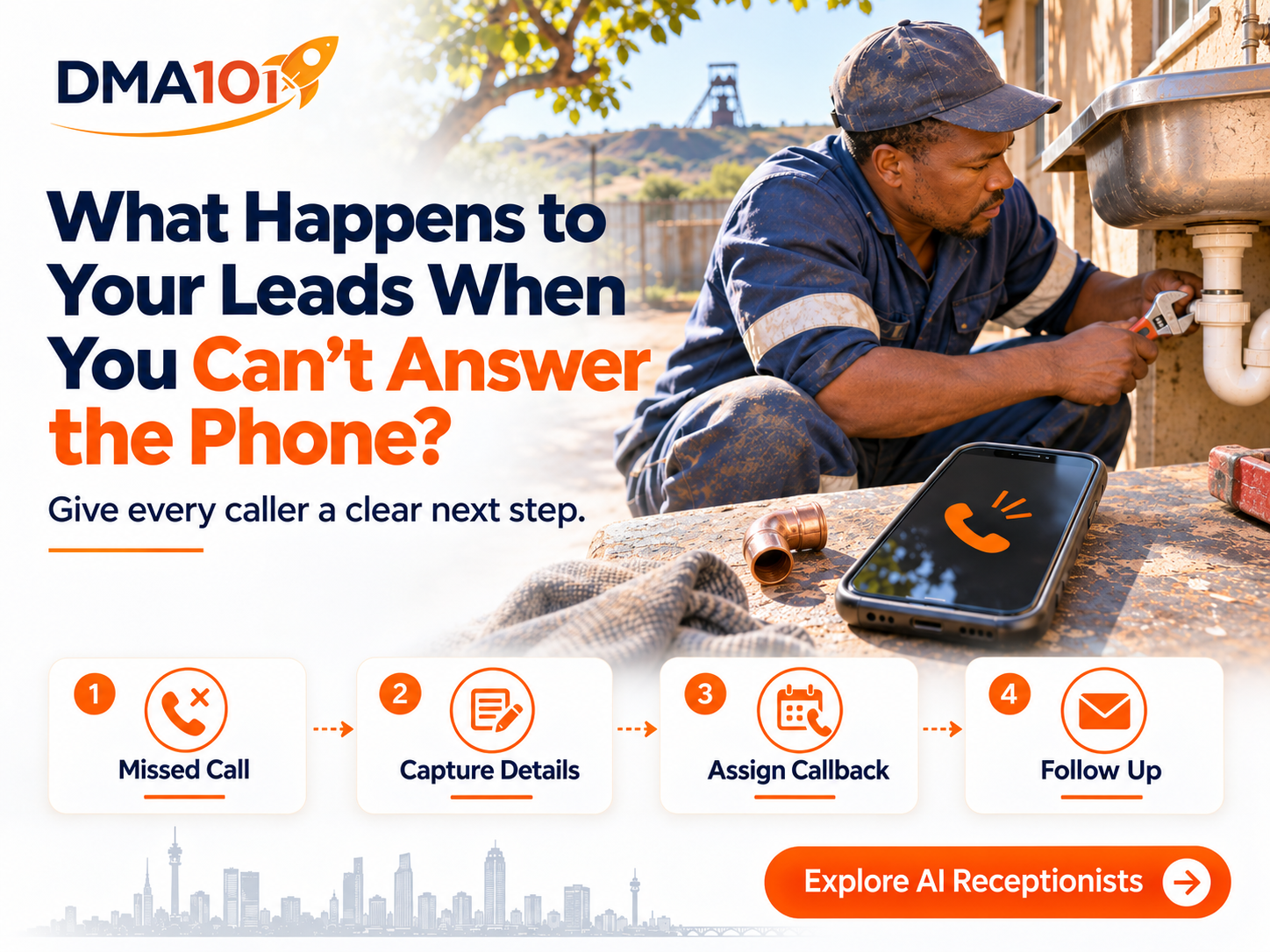
Imagine you are a plumber in Kimberley. It is ten past three on a Friday, you are under a sink, and your phone rings in the bakkie. The caller is a guesthouse owner with a leaking geyser and guests checking in at five. She wants to know one thing before she explains the rest. Can someone come out this afternoon?
You finish the job, wash your hands and call her back. She thanks you, but another plumber is already on the way.
What did that missed call cost you? Possibly a job. Possibly nothing, if your afternoon was already full. What the call log can't tell you is what the customer needed, how long she could wait, or whether there was another way you could have helped her. For a small business spending time and money getting the phone to ring, that is a gap worth understanding.
What Customers Do After the Phone Rings Out
A missed call leaves the next move to the customer. Whether they try again depends partly on why they chose you in the first place.
Someone who found three plumbers on Google can tap the next number in seconds. Someone whose neighbour specifically recommended you may be happy to wait until tomorrow, provided they know you received the enquiry. An existing customer calling to change an appointment may send a WhatsApp as well. By lunchtime, your team could be looking at a missed call, a voicemail and a WhatsApp that all belong to the same person.
The common thread is uncertainty. From your side, you are busy serving a customer. From the caller's side, there is no way to tell whether you are busy for five minutes, closed for the weekend or no longer using that number. A useful response answers the question they are left with: "What happens now?"
What the Research Says About Phone Enquiries
Invoca's 2026 Lead Conversion Benchmarks Report analysed more than 70 million calls across ten industries. Across its customer base, 56% of inbound calls reached a person. Among calls that a person answered, 38% were classified as sales leads. Of those leads, 42% converted during the call. Those figures describe different stages of the conversation. A call can be a supplier checking an address, a customer following up on a repair, or someone ready to book. Each has a different value to the business.
These are figures from one provider's customer base, so use them as context for a South African business. The remaining 44% can't be counted as lost customers. Some callers may have received the information they needed from an automated system. Others may have called back or booked through another channel. Your own records are where you can find out which of those things actually happened.
Timing also deserves attention. Research published in Harvard Business Review found that companies attempting to contact a web enquiry within an hour were nearly seven times as likely to have a meaningful conversation with a decision-maker as those waiting even an hour longer. The study measured online leads and conversations, so it can't tell a Kimberley plumber how many jobs a faster callback will win. It does suggest a practical question for any owner: when we finally reach the customer, is the decision still open?
Quick answer
A missed call does not have to become a lost lead. The three practical ways to handle a call you can't take are:
- Give someone responsibility for calling back
- Send a missed-call text that earns a reply
- Let an AI voice receptionist answer when your team is busy
The right approach depends on how many calls you miss, when you miss them, and what your callers need to decide.
Match Your Response to the Decision the Caller Needs to Make
Think about two calls to the same plumbing business. The guesthouse owner needs someone to confirm today's availability. A homeowner planning a bathroom renovation wants to arrange a site visit next week. Sending both people a link to the same booking page might suit the homeowner beautifully while leaving the guesthouse owner wondering whether anyone is coming.
A small team can handle those calls differently with a few simple rules.
That last row matters. Few things frustrate an existing customer faster than calling about an installation booked for tomorrow and receiving a cheerful message inviting them to become a new customer.
Three Practical Ways to Handle a Call You Can't Take
1. Give Someone Responsibility for Calling Back
For a business that misses only a handful of calls, a clear handover may solve most of the problem. Decide who checks missed calls, when they check them, and who covers when that person is away. A shared call list can be as simple as a caller's number, the time, the person responsible and the outcome.
Give the customer a callback window your team can keep. "Our workshop is closed now. If you leave your name and number, Lerato will return your call tomorrow between 8 and 9" gives the caller enough information to plan. Make sure Lerato has that hour set aside. A specific promise only helps when someone owns it.
2. Send a Missed-Call Text That Earns a Reply
A short message can help when you can't speak but can read a reply between jobs. Identify your business, acknowledge the call and ask one easy question. Here is a version a local service business could adapt during working hours.
"Hi, it's Kabelo from the workshop. Thanks for calling. I'm with a customer and can ring you back before 3 this afternoon. What vehicle are you calling about?"
The reply gives Kabelo a head start. If the caller says, "It's the white Polo I dropped off this morning," he can check with the mechanic before phoning. If they ask for a service quote, he can have the right questions ready.
Use different wording after hours. Check what happens when someone calls twice in five minutes, too. They should receive one helpful acknowledgement and have a reply channel somebody actually checks. Keep that exchange focused on the reason they called.
3. Let an AI Voice Receptionist Answer When Your Team Is Busy
A text is useful if the customer is willing and able to switch channels. An AI voice receptionist lets the conversation continue on the call they have already made. You can configure it to answer overflow or after-hours calls, introduce itself as a virtual receptionist, ask what the caller needs and follow the rules you set for your business.
For the guesthouse owner, that could sound like this:
"Thanks for calling. I'm the virtual receptionist. I can check whether the plumber on duty is available or take a message for a callback. Which area is the property in?"
The important part comes after the greeting. If the plumber accepts the transfer, the caller can explain the problem directly. If the plumber doesn't pick up, the receptionist should tell her that availability is still unconfirmed, check her callback number and pass on the request. She can then decide whether she has time to wait. Nobody has promised a bakkie that hasn't left the yard.
For an appointment-based business, the same idea works differently. A salon might allow its receptionist to book a standard wash and cut from a live calendar, while sending colour corrections to a stylist for a consultation. The owner decides which services have predictable durations, which questions have approved answers, and when a person needs to take over. Before going live, phone your own number and try both requests. Then ask for a fully booked Saturday and see what the caller actually hears.
Work Out What Missed Calls Are Worth to Your Business
Start with a week of calls. Group repeat attempts from the same person, separate existing customers from new enquiries where you can, and record what happened after the callback. Leave unknown outcomes marked unknown. If someone tells you they have already booked elsewhere, that is worth recording too.
Here is an illustrative example. A workshop logs 20 missed calls in a week. After removing repeat attempts, it identifies 15 callers. The team reaches ten of them. Six wanted quotes, three were following up on existing jobs, and one had dialled the wrong number. Two of the six quote enquiries become completed jobs worth R1,500 each.
The owner can now identify R3,000 in invoiced work from callers the team reached after missing their calls. That is revenue before costs. The five unreachable callers still have an unknown value. This gives the owner something more useful than multiplying 20 missed calls by the average invoice and assuming the result was lost.
After a month, look for patterns. Do most missed enquiries arrive while everyone is opening the workshop? Does the phone ring out during lunch even though someone is available in the back office? Do callers receive a quick text but wait until the next day for a person to answer their reply? Each finding points to a different fix. One may need a change to call routing. Another may need an extra pair of hands for half an hour. A third may be a good fit for a voice receptionist.
Where to Start
Call your business number as a customer would. Try once during a busy period and once after closing. Listen to the greeting all the way through. Leave a realistic enquiry. Then check who receives it, what information they get and how long it takes someone to respond. That short exercise can show you more about your customer's experience than a month of counting rings.
Handle Every Missed Call With DMA101
At DMA101, we help South African businesses set up AI voice receptionists, missed-call replies and booking workflows around the way their teams actually work. If you would like help with yours, bring us one real example of a call you regularly miss. We can use it to map out what the caller should hear, who should receive the enquiry and how your team will know it has been handled.
Talk to DMA101 about the calls you are missing, and let us help you turn more of them into booked work.
Stop Missing the Calls You Paid to Get
Every missed call could be a new booking, a returning customer or an urgent job. Let us set up a call-handling system that captures the enquiry, routes it to the right person and follows up before the decision moves on.
Talk to DMA101
Written by Digital Marketing Agency 101
Founder & Digital Growth Strategist at DMA101. Helping ambitious businesses build complete digital growth systems that convert.
Read more about our methodology →Have thoughts on this?
We'd love to hear your perspective. Join the conversation on LinkedIn or reach out directly.
Keep Reading
How Much Does Website Maintenance Cost in South Africa? A Small Business Guide
Your hosting is paid and your website opens. But are booking enquiries reaching the right person? Here's what website maintenance can cover and how to compare the cost.
Read Article BrandingWhat Should a Brand Identity Package Include? A South African Small Business Guide
A signwriter, a packaging supplier and a WhatsApp profile each need something different from your logo. Here's how to choose a brand identity package that works for all three.
Read ArticleHow We Can Help
Events Management System
Ticketing, RSVP, QR check-in, payment processing, automated reminders, and CRM integration for professional events of any size.
Explore ServiceBasic Website Design (1-5 Pages)
Perfect for local businesses needing a clear, professional online presence. Includes home, about, services, and contact pages.
Explore ServicePremium Website Design (5-10 Pages)
Ideal for growing businesses. Includes advanced layouts, lead capture forms, service detail pages, and basic SEO.
Explore ServiceGet Growth Strategies in Your Inbox
Join other ambitious business owners receiving our best insights on websites, automation, and lead generation.
We respect your privacy. Unsubscribe at any time.
Ready to implement these strategies?
Partner with DMA101 to elevate your brand and build a premium digital presence.
Start the 60-Second Fit Check