

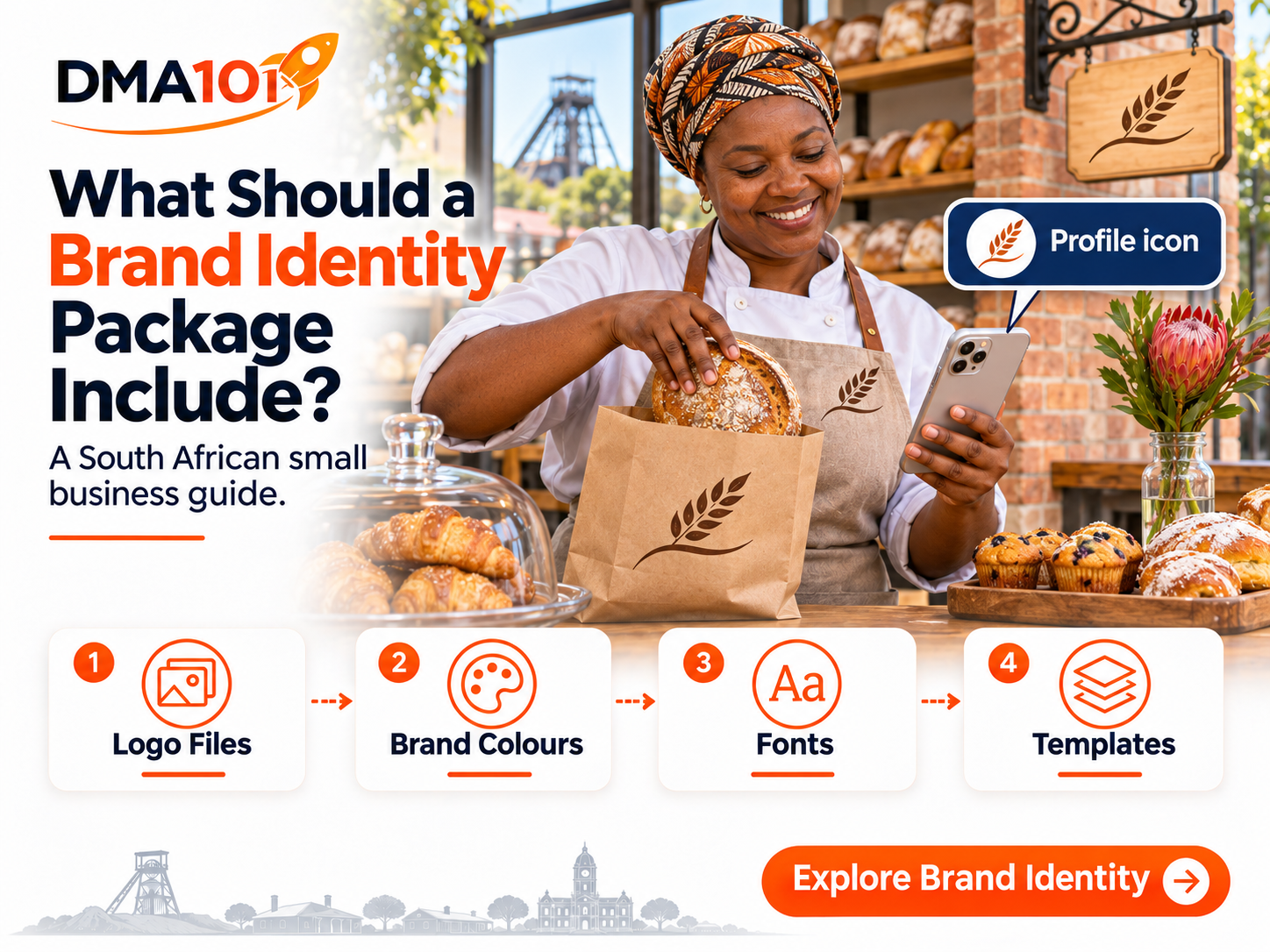
A Kimberley bakery owner approves her new logo on Friday. On Monday, she sends it to the signwriter for the shopfront, the supplier printing her brown paper bags and the colleague setting up her WhatsApp Business profile.
The signwriter asks for the vector artwork. The bag supplier wants a version that prints in one colour. On WhatsApp, the bakery's name is so small inside the profile circle that customers can barely read it. The owner checks her email. The only attachment is a JPG of the logo on a white background.
If you're comparing design quotes, that's the situation you want to think through before you approve one. A practical brand identity package should include the agreed versions of your logo, files you can use online and in print, colour and font specifications, and a short guide showing how everything fits together. Beyond those basics, choose the items your business will actually use. For the bakery, a stamp for its paper bags might be worth more than a folder full of social media templates.
Quick answer
A practical brand identity package for a South African small business normally includes:
- The agreed logo versions for light, dark and single-colour use
- Supplier-ready files in formats your printers and signwriters accept
- Colour values for digital and print, plus named fonts with usage terms
- A short brand guide showing how the elements sit together
- Editable templates for the items your team updates regularly
No package needs to include everything a large corporation would. Choose the items your customers will actually see and your team will actually use.
What's the Difference Between a Logo and a Brand Identity Package?
Your logo is the mark people use to recognise your business. Your visual brand identity includes the choices that make the rest of your material recognisable too: the lettering on your price list, the colours on your packaging, the style of your photographs and the way those elements sit together.
Think about what happens when the bakery needs a new price card for its counter. With only a logo, the person making the card still has to choose the heading font, price layout and colours. With a useful identity package, they can open an agreed template, change "Milk tart R85" to "Milk tart R90" and print the new card. They can handle a routine price change themselves, and the card still looks like it belongs in the same shop.
When an agency offers a "branding package" or "corporate identity package", ask for an itemised list. One quote might cover a logo and stationery. Another might include customer research, messaging, photography or packaging design. Those are different amounts of work, even when the package names sound similar.
Which Logo Files Should Your Designer Supply?
Ask the designer to organise the handover by what you'll use each file for. A folder called "Send to signwriter" is a lot more helpful on installation day than six files called "Logo Final".
| What you want to do | What to ask for | What to check |
|---|---|---|
| Put the logo on a shopfront, vehicle or large banner | Vector artwork in a format your supplier accepts, such as SVG, EPS or a vector PDF | A vector logo can scale cleanly. A PDF can also contain a low-resolution picture, so the .pdf extension alone doesn't tell you what's inside. |
| Place the logo over a photo or coloured background | A PNG with a transparent background, plus a version designed for dark backgrounds | Open it on both white and navy. Check that the lettering stays visible and there's no unwanted white box. |
| Use the logo on WhatsApp or social media | A square profile version with room around the edges | Preview it as a small circle on your phone. If the business name becomes unreadable, ask for a simpler icon or arrangement. |
| Stamp bags or print in a single ink | A one-colour version approved for the intended use | Ask the supplier to show it at the actual print size. Fine lines that look lovely on screen may disappear on textured paper. |
| Update menus, quotes or posts yourself | The agreed editable templates in software your team can use | Ask a staff member to change a price, replace a photo and export the result before you sign off. |
A useful distinction here is supplier-ready artwork versus editable working files. Your signwriter may have everything needed to reproduce the logo, while your team still needs an editable menu. Equally, handing over a designer's working file won't help much if nobody in your business owns the software or has access to the fonts. Agree on what you'll receive and who needs to open it.
What Belongs in a Small Business Brand Guide?
A small business can get plenty of use from a short guide. The test is whether a new staff member or outside supplier can use it to make an everyday decision.
Logo use
Show the main logo, a compact version if needed, and the versions approved for light and dark backgrounds. Include an example of the smallest size at which the name is still legible.
Colours
Give the team the HEX or RGB values for digital work and the agreed print colour specifications for suppliers. If colour matters to the finished product, ask to see a proof on the intended material. The bakery's orange can look bright on a phone, softer on a white label and quite different on a brown paper bag.
Fonts
Name the fonts used for headings and body text. Explain where staff can get them, what licence or subscription they need, and what alternative to use in everyday documents. An invoice template becomes awkward if the bookkeeper opens it and all the prices shift because a font is missing.
Examples
Ask to see the design on something you actually use. One finished menu and one sample bag can answer more questions for a bakery than several pages of abstract design rules. A consultant might get more value from a proposal cover and an inside page showing a fee table.
Which Extras Are Worth Paying For?
Look at what customers see before they buy, when they buy and after they buy. That gives you a sensible order for spending your design budget.
For the bakery, customers might discover the business on WhatsApp, read a price list, then carry their purchase home in a branded bag. Its first package could cover a profile icon, an editable price list and a one-colour packaging mark. A consultant who wins work through written proposals might prioritise a proposal template, a presentation and an email signature. Both businesses need a recognisable identity. They need it to do different work.
Be precise about what a deliverable includes. "Packaging design" could mean placing an existing logo on one sticker, or designing several labels to fit different products and sizes. "Social media templates" could mean five editable layouts or five finished images with fixed text. If your employee needs to replace the product and price every Thursday, that difference matters.
What Affects the Price of a Brand Identity Package in South Africa?
The most useful way to compare quotes in rand is to give each designer the same short brief. Tell them what the business does, where the brand will appear and what your team must be able to edit. Then compare the following details alongside the total:
- Design work. Are you commissioning a new identity, refining an existing logo or asking someone to prepare missing files?
- Concepts and revisions. How many initial directions will you see? Once you choose one, how many rounds of changes are included?
- Applications. Is the designer supplying the logo alone, or also laying out packaging, vehicle graphics, stationery or editable templates?
- Handover and permissions. Which final and working files will you receive? What uses are agreed for the final artwork? Do any fonts, photographs or illustrations have separate licence terms or costs?
- Production and total payable. Does the quote cover design only, or also proofs, printing, delivery or installation? Is VAT included where applicable?
For example, if one quote includes a bag design and another includes 1,000 printed bags, put those amounts on separate lines before comparing them. Do the same with once-off design fees and recurring subscriptions. You want to know both what you'll pay to launch and what it will cost to keep using what you've bought.
A Brand Handover Checklist You Can Use Before Signing Off
- 1 Open the files yourself. Can you find the right version for your website, social profile and print supplier without asking the designer?
- 2 Try the logo at real sizes. View the profile image on your phone and print your smallest label at actual size.
- 3 Ask one supplier to check the artwork. Your signwriter, printer or embroiderer can confirm whether the supplied format and detail suit their process.
- 4 Make one routine edit. Change a menu price, swap a photograph or update the date on a proposal. Check that your staff can save and export it using their own accounts.
- 5 Keep the practical details together. Store the approved files, colour values, font information, agreed usage terms and supplier notes in a folder your business controls.
For the Kimberley bakery, a good handover has a simple outcome. When the signwriter phones, the owner knows which file to send. When the bags need reordering, the supplier already has the approved artwork. And when the price of milk tart changes again, someone at the counter can update the card.
Build a Brand Identity That Works in the Real World
Where will your brand appear first? Tell DMA101 which three items your customers will see most often and who needs to update them. We'll help you choose the design work, templates and files your business will actually use.
Files your suppliers can use. Templates your team can edit. An identity that holds together wherever it appears.
Build Your Brand Identity With DMA101
Stop handing suppliers a JPG and hoping for the best. We'll create the logo versions, colour and font specifications, templates and brand guide your business actually needs, organised so your team and suppliers can use them.
Start the Fit Check
Written by Digital Marketing Agency 101
Founder & Digital Growth Strategist at DMA101. Helping ambitious businesses build complete digital growth systems that convert.
Read more about our methodology →Have thoughts on this?
We'd love to hear your perspective. Join the conversation on LinkedIn or reach out directly.
Keep Reading
How Much Does Email Marketing Cost in South Africa?
Can you email 500 customers for free? See how sending limits, campaign work and your own time affect the monthly cost for a South African small business.
Read Article WebsitesHow Much Does Website Maintenance Cost in South Africa? A Small Business Guide
Your hosting is paid and your website opens. But are booking enquiries reaching the right person? Here's what website maintenance can cover and how to compare the cost.
Read ArticleHow We Can Help
Events Management System
Ticketing, RSVP, QR check-in, payment processing, automated reminders, and CRM integration for professional events of any size.
Explore ServiceBasic Website Design (1-5 Pages)
Perfect for local businesses needing a clear, professional online presence. Includes home, about, services, and contact pages.
Explore ServicePremium Website Design (5-10 Pages)
Ideal for growing businesses. Includes advanced layouts, lead capture forms, service detail pages, and basic SEO.
Explore ServiceGet Growth Strategies in Your Inbox
Join other ambitious business owners receiving our best insights on websites, automation, and lead generation.
We respect your privacy. Unsubscribe at any time.
Ready to implement these strategies?
Partner with DMA101 to elevate your brand and build a premium digital presence.
Start the 60-Second Fit Check